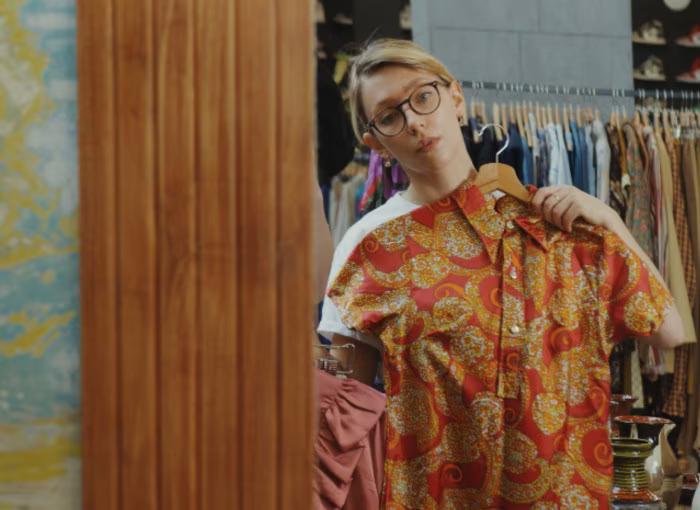
Have you ever looked at your wardrobe, stuffed to the gills with polyester “micro-trends” that were manufactured three weeks ago, and felt a strange, hollow sense of exhaustion? It’s a specific kind of 21st-century fatigue. We are drowning in “newness,” yet we’ve never felt more culturally impoverished. We buy, we wear once, we discard. It’s a linear treadmill that leaves our bank accounts leaking and the planet gasping for air.
But what if I told you that the most radical, sophisticated, and aesthetically rewarding shopping experience isn’t happening on a high-street catwalk or a luxury boutique in Mayfair? What if the real “it-bag” is actually a vintage leather find from 1984 that carries the ghost of a thousand stories?
Welcome to the world of the Oxfam Online Shop. This isn’t just a digital charity bin. It is a curated, high-velocity portal into a circular economy that is currently dismantling everything we thought we knew about retail therapy. It’s where the thrill of the hunt meets the clarity of a clean conscience. And frankly, it’s about time we had an analytical look at why this platform is the only place you should be spending your “guilt-money.”
The Anatomy of the “Fashion Hangover”: An Analytical Post-Mortem
Before we dive into the treasure chest, we need to address the elephant in the room: the catastrophic failure of the traditional retail model.
Analytically speaking, the “Fast Fashion” industry operates on a model of planned obsolescence. It relies on you feeling “behind” the curve every fourteen days. It’s a psychological hijack. But the hangover is real. The carbon footprint of a single pair of new jeans is equivalent to driving a car for 80 miles. Can you really justify that for a pair of pants that will lose their shape after three washes?
The Oxfam Online Shop represents the “Counter-Strike.” It is the architectural blueprint for a world where we stop treating clothing like disposable tissues and start treating them like assets. When you buy from Oxfam, you aren’t just “recycling”; you are performing an act of “Digital Archaeology.” You are rescuing high-quality materials—wool, silk, leather, heavy cotton—from the landfill and reintroducing them into the cultural bloodstream.
Why does a vintage Burberry trench coat from the 90s feel better than a brand-new one from a fast-fashion knock-off site? Because the vintage one has integrity. It was built to last a lifetime, not a season. And at the Oxfam Online Shop, you’re getting that structural superiority for a fraction of the price. Is there anything more satisfying than winning the “Value vs. Quality” equation?
The “Thrill of the Hunt” 2.0: Digitizing the Serendipity
We’ve all been there: the dusty, cramped charity shop where you have to elbow your way through racks of beige cardigans to find one decent silk scarf. It’s charming, sure, but who has the time?
The genius of the Oxfam Online Shop is that it has perfected the “Curated Chaos.” They have taken the serendipity of the thrift store and layered it with the precision of a high-end e-commerce platform. You can filter by “Vintage,” by “Designer,” by “Collectibles,” or even by “Sourced by Oxfam” (their range of new, ethically produced goods).
It’s a dopamine hit unlike any other. When you refresh the “New Arrivals” page, you aren’t seeing 5,000 identical units of a mass-produced blouse. You are seeing 5,000 unique opportunities. That one-of-a-kind 1970s tea set? That first-edition Graham Greene novel? That hand-knitted oversized jumper that looks like it belongs in a high-fashion editorial? Once they’re gone, they’re gone.
Doesn’t that make the purchase feel more “earned”? In a world where everyone is wearing the same “trending” outfit from a TikTok haul, the Oxfam shopper is the one standing out. You become the curator of your own life. You aren’t just a consumer; you’re a collector.
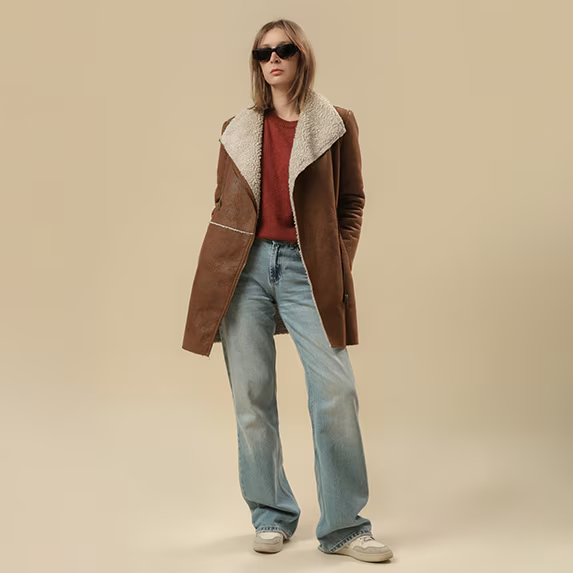
The “Sourced by Oxfam” Paradox: Can New Be Ethical?
Now, let’s get analytical about their “new” products. Many people assume that a charity shop can only sell “old” things. But the Oxfam Online Shop has developed a “Sourced” range that challenges the very foundations of the manufacturing industry.
They vet their suppliers with a ferocity that would make a corporate auditor weep. Fair trade? Check. Sustainable materials? Check. Living wages for the artisans? Non-negotiable.
Whether it’s a bar of artisanal soap, a recycled sari tote bag, or a piece of ethically mined jewelry, these items represent a “New Standard.” It’s an admission that we do occasionally need new things—but those things shouldn’t come at the cost of someone else’s dignity. By mixing these ethical “new” items with their vast library of “pre-loved” treasures, Oxfam creates a holistic lifestyle ecosystem. It’s a one-stop-shop for the conscious soul.
The Psychology of the “Power Pound”
Let’s talk about where the money actually goes. This is where the Oxfam Online Shop moves from being a “cool place to buy clothes” to a “global engine for change.”
When you buy a luxury handbag from a big-box retailer, that money disappears into a black hole of corporate dividends and offshore tax havens. When you spend that same £50 at Oxfam, that money is converted into life-saving resources.
Think about the analogy of “Currency Conversion.” Your “Shopping Currency” is being converted into “Impact Currency.” That dress isn’t just a dress; it’s a month’s supply of clean water for a community in crisis. Those boots aren’t just boots; they’re a toolkit for a farmer to withstand the climate emergency.
How does that change your relationship with “Buying”? Suddenly, the guilt associated with spending money evaporates. You aren’t “draining” your resources; you’re “reallocating” them to where they can do the most good. It’s the ultimate “Win-Win.” You get the aesthetic upgrade, and someone else gets a life upgrade. Why isn’t every shop run like this?
Curating a Home with a Soul: Beyond the Wardrobe
The Oxfam Online Shop isn’t just about what you wear on your back; it’s about the environment you build around yourself.
Have you noticed how modern homes are starting to look like hotel lobbies? Minimalist, gray, and completely devoid of personality. We buy our furniture from the same Swedish flat-pack giant and our “art” from the same mass-market printers.
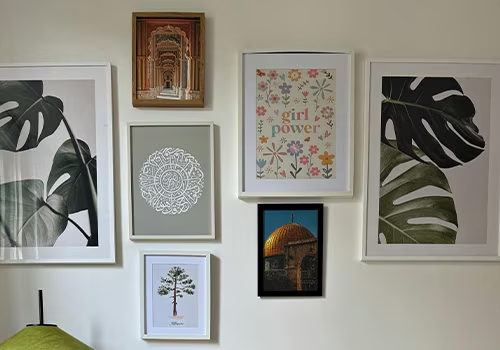
The homeware section of the Oxfam site is the antidote to this “Bland-ification” of the home. It’s filled with mid-century glassware, quirky ceramics, and textiles that actually have a texture. These are the items that start conversations. When a guest asks, “Where did you get that stunning brass lamp?”, isn’t it much more satisfying to say, “I found it on the Oxfam shop—it’s an original 60s piece,” rather than “Oh, it was in the sale at the mall”?
And then there are the books. Oh, the books! The Oxfam Online Shop is arguably the greatest used bookstore in the world. From rare collectibles to the latest thrillers, their selection is staggering. There is a specific kind of magic in a used book—the dog-eared pages, the smell of aged paper, the occasional inscription on the flyleaf. It’s a physical connection to the person who read it before you. It’s a reminder that we are all part of a larger, ongoing human story.
The Analytics of “Cost-Per-Impact”
If you’re a data-driven person, let’s look at the ROI (Return on Investment).
- Cost-Per-Wear: A high-quality vintage wool coat for £40 that lasts 10 years has a significantly lower “Cost-Per-Wear” than a £20 synthetic coat that falls apart in six months.
- Environmental ROI: By choosing second-hand, you are effectively “saving” the thousands of liters of water and the kilos of CO2 required to produce a new garment.
- Social ROI: 100% of the profits (after costs) go toward Oxfam’s mission to end the injustice of poverty.
When you stack these up, the Oxfam Online Shop isn’t just a “budget” choice; it’s the most logical, high-performance choice you can make. It’s an analytical “no-brainer.”
The Call to Adventure: Your Digital Treasure Hunt Starts Now
So, why are you still reading this?
There is a world of hidden gems waiting for you. There’s a pair of designer heels that were worn once to a gala and are now waiting for a second life. There’s a vintage vinyl record that’s been looking for a turntable to call home. There’s an ethical gift that will make your best friend cry with joy because it actually means something.
The Oxfam Online Shop is a mirror. It reflects who we want to be as consumers. Do we want to be the people who fuel the fire of mindless production? Or do we want to be the alchemists who turn “second-hand” into “second-to-none”?
Stop settling for the generic. Stop participating in the waste. Dive into the filters. Set your price range. And prepare to be surprised.
The hunt is on. And the best part? Everyone wins.